• 1 Post
  • 46 Comments
Joined 2 年前
cake
Cake day: 2023年6月15日

help-circle

  • wjs018@lemmy.worldtoFediverse@lemmy.worldPieFed.World is now open
    link
    fedilink
    English
    arrow-up
    3
    ·
    edit-2
    5 个月前

    Ugh…this one still frustrates me a lot. If I could wave a magic wand and have a different contributor do two things for the project, animated gifs would be one and a more consistent compact layout would be the other.

    Edit: Just want to add that when I was working on the gif problem, I got it working for posts…but you have to click through into the lightbox or to the complete image url…the thumbnail isn’t animated. So, I got partway there, but ran into technical limitations of the specific python library being used. Relevant issue.



  • As somebody that has done a lot of recent work on the UI for piefed, I have tried to make sure that it works even at quite small screen sizes. I actually just submitted a couple commits in the past couple hours to make the navbar across the top of communities/feeds/topics flow smoother across different screen sizes. The PWA is so far my preferred way to use piefed.


  • Edit: Reading is hard and I misunderstood that this post is about promoting lemmy on reddit. I don’t have any experience to contribute with that, but I will leave the rest of my post for posterity.


    By self-promotion, do you mean creating content for youtube/a blog/etc. and then posting it to lemmy? If so, then I think that is fine within reason. In the communities I mod, I have allow self-promotion with these guidelines:

    • Be an active member of the community on other posts too, not just your own content
    • If you post your own content, at least be responsive to questions you might get in the comment section
    • Rate limit your self-promotion so that it doesn’t feel spammy (no defined rate, more vibes-based)

    I have a couple posters that have posted article or projects that they have created and been fine. I also have a couple people I have ended up banning because they would just post links to their own content and vanish otherwise.

    All that said, there is a sizable portion of lemmy that seems to chafe against any kind of corporate-controlled social media. So, there is an inbuilt hostility that can exert an outsized influence in smaller communities.


  • Just for some background information on how most countries tend to rely on larger, more rigorous regulatory bodies…

    I am in the pharma industry (not in vaccines though). Typically the two main regulators that most other countries look to as a reference are either the FDA or the EMA (the EU organization). This usually means that if you can satisfy the requirements of one of these bodies, then it is satisfactory for the other country as well. However, it isn’t universal as each other country will usually have some modifications here and there for whatever reason. The most annoyingly particular ones I have dealt with in the past are China and Japan.


  • I own a Prius (not a PHEV though, just a hybrid) and can corroborate that my mileage goes down significantly in the winter months. It is a combination of a couple factors in my experience.

    • Needing to run the engine more to heat things up for defrosting and heating the cabin.
    • Related to the above, I tend to idle a lot more in the winter while cleaning ice/snow off the car, letting it warm up, or clearing the driveway.
    • Switching to winter tires (Blizzaks) negatively impacts rolling resistance compared to the LRR tires (Ecopias) I use the rest of the year.

    I tend to average ~45 mpg in the summer and ~37 mpg in the winter over the past two years.


  • Starting a new community is an uphill slog. Some tips and observations:

    • Make sure to subscribe to the community from several of the large instances so that it is federated there and people viewing the all feed can see it.
    • If you haven’t yet, make sure to announce the community in !newcommunities@lemmy.world and/or !communitypromo@lemmy.ca
    • If you can think of some kind of recurring post series, it is a good structure to provide a steady drip of content. For latin, maybe something like a weekly post about the etymology of a modern word with a latin root?
    • In general, posts with a lead image generate much more interaction than non-image, discussion posts. So, the meme-type posts can serve a role to help people discover the community.


  • I haven’t been able to post as much this past week compared to normal, but things have been going ok:

    • !anime@ani.social is actually kind of booming right now with the start of a new season of shows. I have seen lots of first-time commenters chiming in on episode threads. It actually hit ~300 users/day at one point over the weekend.
    • !manga@ani.social has been calm but active. There are a handful of other fairly reliable posters that have been able to keep things going while I have been away.

    The not as active ones:

    • !nokotan@ani.social - I inherited this community when the previous moderator had to step away for an extended period of time. The nokotan community in general is very meme-heavy, and I just don’t really know how to engage with that very well. There is only so much non-meme content about the series. So, I am going to try to binge-read the manga and start posting chapter discussion threads when new chapters are released. I just need to find the time to do that.
    • !gundam@ani.social - This is another kind of special case. The current, most active Gundam community is !gundam@possumpat.io. However, that instance announced that they are shutting down later this month. The current users over there were interested in setting up a new community but there wasn’t anybody that wanted to moderate. So, I offered my help in that respect. It just started this past week, so there isn’t much there yet, but I am going to try to keep posting any Gundam-related content I find over there.


  • Recently, in !anime@ani.social, I configured the episode discussion bot to create posts using the poster art of the show rather than just an empty discussion post as a bit of an experiment about the effect of images. I don’t have hard analytics to dig into, but I have noticed that the episode discussion threads have garnered significantly more votes when they have images, and a small increase in comments. Though, the additional comments are usually just wandering folks instead of people that stick around and engage.

    I still don’t let fanart in either the main anime nor manga community because it would too quickly spiral out of control. There is simply too much fanart in existence for these things. Instead, I limit it to official art only, which usually means teasers/posters/trailers. In the manga community, there is a bit of a special case in that I do allow fanart of a series if it was done by a different published author (not just some random pixiv user). This happens sometimes when a series ends and you get other authors drawing commemorative art for it.


  • I work in pharma, regularly writing and filing things with the FDA (and other agencies), and this has been a topic of conversation at work. The good news for people is that the EMA is still a thing in the EU. So, at least the large pharma companies (like the one I work for), are likely to not really change much about their quality control/processes/etc. because we will still need to conform to the EMA guidelines which are typically in line with the current FDA (sometimes more strict, sometimes less so). The real quality concern would be smaller companies that only file for products in the US. They would only need to meet whatever new FDA guidelines come into effect (if they even do, changing stuff like GMP guidance is extremely complicated and time consuming) since the US is their only market.


  • As somebody that mods other communities on ani.social, lemmy has a sizeable portion of its userbase that browses by All rather than by Subscribed. Lemmy also has a sizeable portion of users that are extremely hostile to anything anime or anime-adjacent (just see the lemmy.ml defederation drama from last year for example). So, random downvotes on active posts happen a lot since each new comment pushes that post to the top of the feed when sorted by Active. The important part is the engagement from your community members. One person commenting is worth >100 random up/down votes for keeping a community going.


  • The products I work on are mostly monoclonal antibodies (and the occasional gene therapy product mixed in). So, the types of diseases they are used to treat vary. To be honest, I work on the process/formulation side of the development pipleline and the actual clinical treatment part is pretty much inconsequential to what I do. Some of the past programs I have worked on include treatments for asthma, eczema, multiple myeloma, breast cancer, MS, hemophilia, and tons of others that I don’t remember. Often, when dealing with antibodies, the same medicine can be effective for multiple indications.

    The finished vials, post-lyophilization, sealing, labeling, and packaging, are sent to infusion clinics. There, clinicians will add water to the vials to reconstitute the drugs and then administer them to patients via IV (usually).


  • Watching TC do a video about something I do professionally has been a bit of a trip. For context, I work with freeze dryers (we call them lyophilizers) in pharmaceuticals rather than foods. I help design the lyophilization cycles for biologics and gene therapy products that get preserved through freeze drying. Until this video, I had no idea that people used these instruments for at-home food preservation (which is kind of insane imo).

    The instruments that I work with are typically a much larger version of the bench-scale machine that he is using (usually one of the LyoStar line). However, I have used smaller, bench-scale units as well for some quick and dirty work. I included some pictures at the end behind a spoiler tag. Happy to answer any questions people have.

    Some differences in how I use lyophilizers in a scientific setting as opposed to a home-use food setting:

    • Typically, we only lyo products that are already filled in vials as opposed to a full tray like he’s done.
    • We don’t pre-freeze our products before they go into the lyophilizer. Instead we refrigerate the shelf that the vials are sitting on to freeze the contents before we proceed to the drying steps.
    • Speaking of the shelves, in our instrument, the shelves can move up and down. This is used to compress the vials after the cycle is completely done, fully seating the vial stoppers and sealing them before we open up the main door.
    • Also speaking about stoppering the vials, we typically allow some nitrogen into the chamber before sealing up the vials, at a pressure moderately less than atmospheric pressure. This helps keep the vial sealed until it is properly crimped with a seal.
    • When it comes to drying, we do it in two stages. The primary drying step is when our product is kept cold, but put under vacuum. This removes most of the water, but not enough for our purposes. The secondary drying step is when the product is heated while the vacuum is maintained. This removes the rest of the water. We typically shoot for a residual moisture of <1% for a good cycle.
    • He talks about how long the process takes. I have worked on processes that take from 1-5 days. Typically, the lyophilizer is limited with how much liquid can be removed per unit time. This limit is determined by the geometry of the vent that connects the main chamber with your vials, and the chamber containing the condenser. Also, if you try to dry too quickly, it can damage the product you are trying to preserve.
    • He has some discussion at the end about the end of the cycle and the progress bar. What the instrument is doing is comparing the vapor pressure in the chamber using two different sensors. One of those is sensitive to the vapor pressure of water vapor, and the other is not. So, when things are fully dried out, those two are going to read the same pressure. While drying is still occurring, the sensor that detects water vapor will read a higher pressure. So, the instrument will continue to extend drying until those two pressures are the same.
    Some Pictures

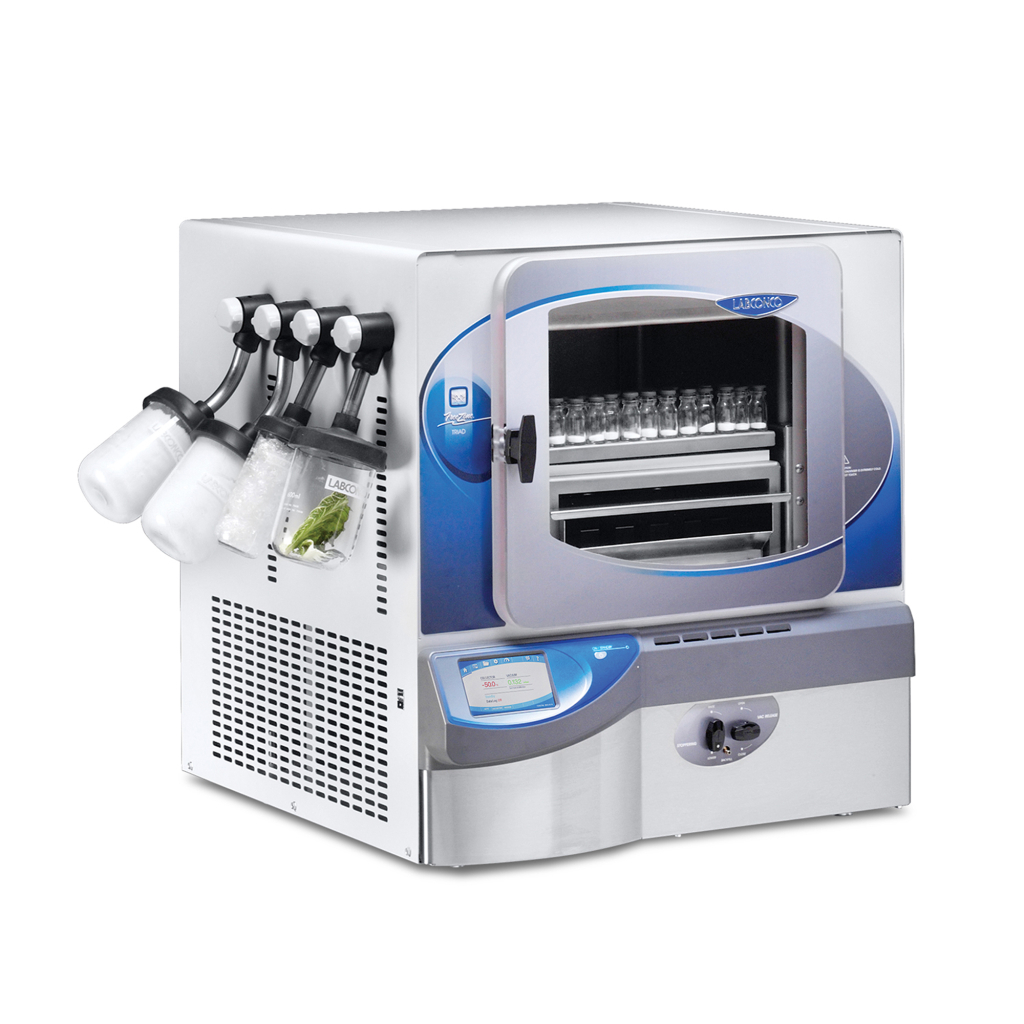
    Benchtop lyophilizer that I have experience using. You can see some vials lined up inside the door. I have never used the bottle connections hanging off the side:

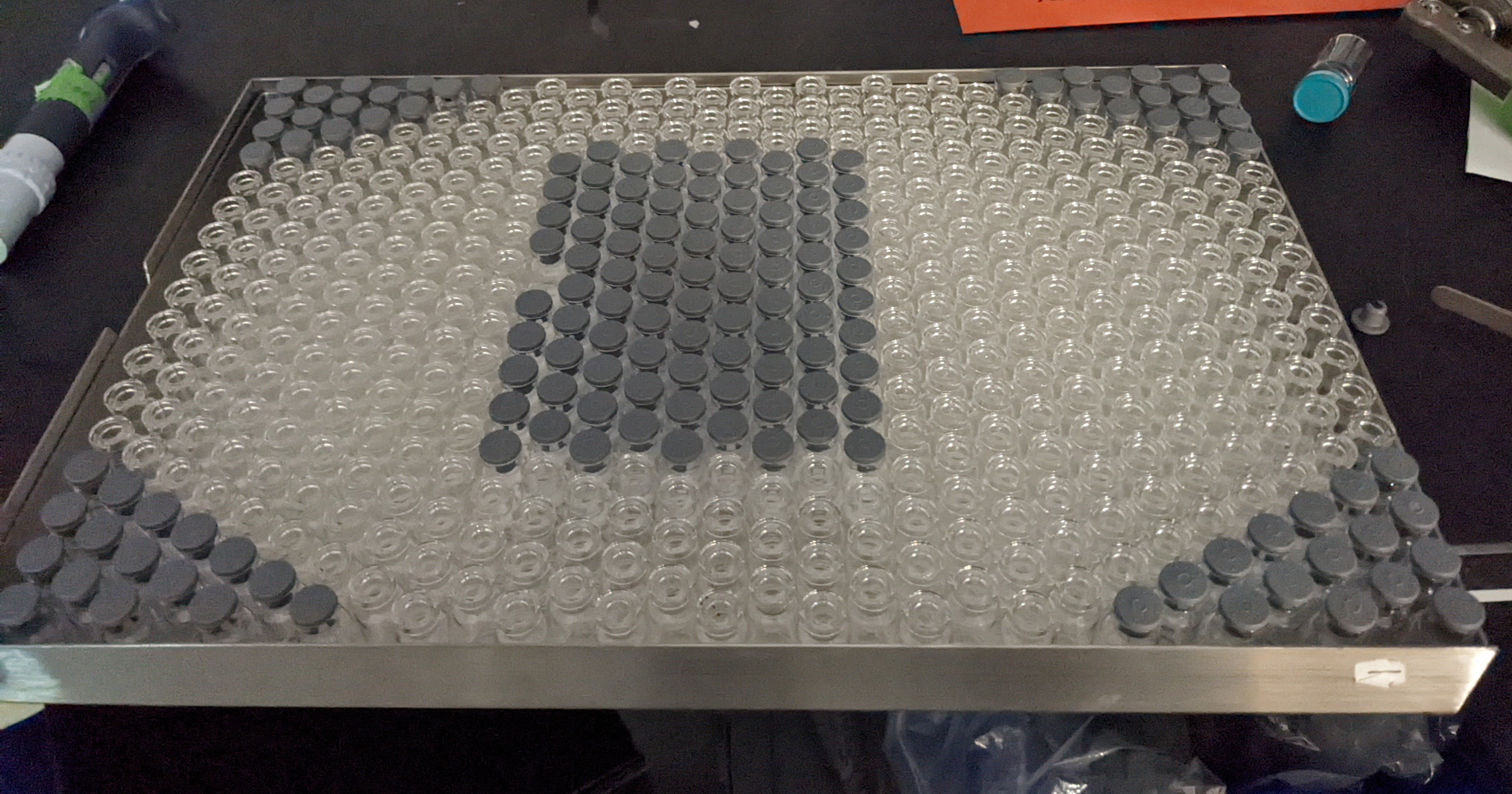
    One of the trays of vials that is loaded before going into the lyophilizer. The vials that are partially stoppered in the middle of the tray actually contain the drug. All the vials without stoppers are empty and simply there to help hold things in place as well as distribute heat predictably through the tray. The stoppered vials in the corners are there to help distribute the weight as the shelves compress to fully seat the stoppers.

    Here are a small number of vials that I ran on a benchtop unit without any spacer vials or the tray. I would never do this for any reason other than to take a picture like this. This is a good view of what a partially stoppered vial looks like. It allows a path for water vapor to escape out the top of the vial.

    Finally, here is a vial post-lyophilization. The liquid has turned into a solid, white cake at the bottom of the vial. This is because most lyophilization formulations include sugars that provide structure for the cake and keep it porous. The sugars provide protection against freeze/thaw stress for the molecule of interest as well. The porosity of the cake allows for quick and easy reconstitution by adding water, usually in <30 seconds or so.